How Do You Evaluate Maine Car Accident Lawyers for Serious Injury Claims?
Selecting the right legal representation requires objective criteria rather than relying on advertisements. For serious cases, your attorney must possess the resources to go toe-to-toe with national insurance carriers. When evaluating top rated car accident lawyers in Maine, look for these specific indicators of capability:
- Trial Readiness and Resources: Serious injury claims require a firm that prepares every case as if it is going to trial. This meticulous preparation provides the necessary leverage to secure maximum compensation during negotiations. If a firm lacks the financial resources to hire top-tier experts or file a lawsuit, they may pressure you to accept a subpar insurance offer.
- Immediate Evidence Preservation: Strong firms take immediate action to preserve critical evidence. This includes sending formal preservation letters for Electronic Control Module (ECM) or Event Data Recorder (EDR) “black box” data, securing dashcam and store surveillance video, obtaining 911 and Computer-Aided Dispatch (CAD) timestamps, and documenting winter road-maintenance or black-ice records.
- Empathetic and Clear Communication: You should have a primary point of contact and a defined update cadence to reduce stress throughout the legal process. You deserve honest, direct answers about the strengths and weaknesses of your case.
- Transparent Fee Structures: Confirm that the firm operates on a contingency fee basis. This means there are no upfront costs, and they only get paid if they secure a recovery for you.
Understanding the benefits of hiring an experienced personal injury attorney is the first step toward protecting your long-term physical and financial recovery.
Why Does Trial Experience Matter for Insurance Negotiations?
Insurance companies keep detailed records of which law firms actually go to court and which ones settle quickly for lowball offers. Hiring a firm with a proven trial pedigree forces insurers to take your serious injury claim seriously.
- Leverage in Negotiations: When insurance adjusters know your attorney is fully prepared to present your case before a Maine jury in Portland or Lewiston, they are far more likely to offer a fair settlement. Trial preparation is the single most effective negotiation tool.
- Accurate Case Valuation: Experienced trial lawyers know how to calculate the true, long-term cost of catastrophic injuries, including future medical care, lost earning capacity, and ongoing pain and suffering. They do not rely on basic insurance calculators that undervalue your human experience.
By working with a firm that understands how to increase settlement value in a personal injury claim in Maine, you protect yourself from accepting an early, inadequate offer. When deciding should I settle or go to trial?, having a seasoned trial advocate in your corner ensures that the choice is yours, not the insurance company’s.
How Do Local Case Factors and Maine Laws Affect Your Claim?
Maine has unique legal statutes and geographic realities that directly impact how car accident claims are handled and resolved.
- Six-Year Statute of Limitations: Maine has one of the longest statutes of limitations in the nation for general personal injury claims (six years under Title 14, §752). However, waiting to file can result in lost evidence, degraded physical scene data, and faded witness memories.
- Wrongful Death Deadlines: If a crash results in a tragic fatality, the statute of limitations drops to three years for wrongful death claims, with specific statutory caps on non-economic damages.
- Modified Comparative Negligence: Under Maine law, you can only recover damages if your fault is less than 50%. If you are found to be 50% or more at fault, you recover nothing. Legally, your compensation is reduced by an amount reflecting your negligence, rather than a strict mathematical percentage.
- Government Claims and the 365-Day Rule: If your accident involved a state, county, or municipal vehicle (such as a snowplow or school bus), you must file a formal written notice of claim complying with the Maine Tort Claims Act within 365 days of the injury. There is no liability for government entities regarding sidewalk maintenance.
- Premises Liability and Contractor Standards: For premises liability issues that may intersect with an accident scene, Maine law applies a “duty of care to any non-trespasser” standard. Furthermore, contractors have no independent duty to the public unless they created the problem.
Understanding these rules highlights the importance of seeking legal help: why you need a car accident lawyer in Maine. Local factors dictate how a case is built, which is why Maine car accident lawyers discuss alarming CDC vehicle crash reports to stay ahead of safety trends and shifting defense tactics.
What Should You Expect When Working with a Maine Car Accident Attorney?
Understanding the financial and procedural aspects of a personal injury claim helps you make informed decisions about your legal representation.
- The Contingency Fee Model: Most Maine personal injury attorneys charge a contingency fee, typically ranging from 33.3% to 40% of the final recovery. This means you pay nothing out of pocket, and the attorney’s interests are fully aligned with yours.
- Case Costs and Expenses: Ensure you clarify who advances the costs of litigation—such as expert witness fees, medical record retrieval, and court filing fees—and how medical liens or subrogation claims are resolved at the end of the case.
- Seatbelt Admissibility: Under Maine Title 29-A §2081, the failure of an adult to wear a seatbelt is not admissible as evidence of comparative negligence in a civil trial. The defense cannot use this to reduce your recovery.
Navigating these complex financial structures is essential when learning how to get the most out of your personal injury claim. Having an advocate who excels at navigating insurance companies ensures your rights are protected from day one.
How Do Attorneys Maximize Recovery for Catastrophic Injuries?
Serious cases involving traumatic brain injuries (TBI), spinal cord damage, amputations, or complex fractures require a sophisticated approach to documenting damages.
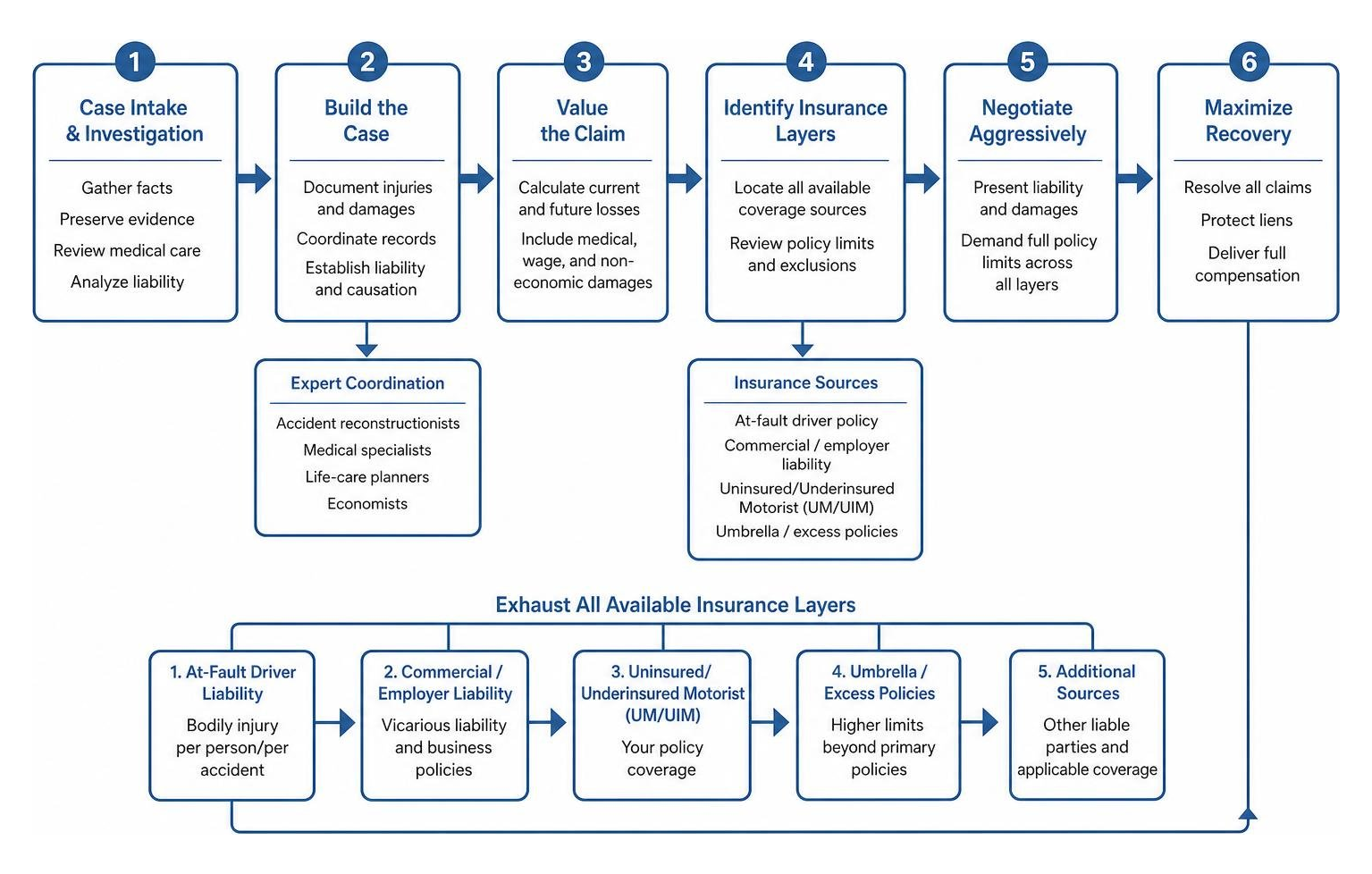
- Expert Coordination: Strong legal teams collaborate with accident reconstructionists, medical specialists, life-care planners, and economists to build an undeniable record of your physical and financial losses.
- Exhausting Insurance Layers: Experienced lawyers look beyond the standard auto liability policy to identify additional coverage, such as commercial umbrella policies, employer liability, and Uninsured/Underinsured Motorist (UM/UIM) benefits.
This comprehensive approach is critical when addressing the question: what if the at-fault party doesn’t have enough insurance to pay my claim? Experienced counsel will exhaust every possible avenue of recovery to ensure your medical bills and future care are fully covered.
When Is the Right Time to Contact a Maine Trial Lawyer?
While Maine’s six-year statute of limitations provides a long window to file a lawsuit, waiting to seek legal counsel can severely damage your claim.
- Protecting Your Statements: Insurance adjusters often reach out immediately after a crash to obtain recorded statements. These statements can later be used to shift blame under Maine’s modified comparative negligence rules.
- Preserving Physical Evidence: Skid marks fade, vehicles are repaired or destroyed, and local businesses delete security footage. Contacting an attorney early ensures this evidence is legally preserved.
Knowing when should you call a personal injury lawyer? can make the difference between a fully compensated recovery and a denied claim. Seeking a free case evaluation immediately after a crash allows an experienced team to begin protecting your rights while you focus on healing.
Maine Car Accident Claims: Frequently Asked Questions
What should I do immediately after a serious car accident in Maine?
Your first priority is safety and medical care. Call 911 to report the crash and request emergency medical services. If you are physically able, take photos of the vehicles, road conditions, and any visible injuries. Avoid discussing fault at the scene, and do not give a recorded statement to any insurance adjuster until you have consulted a lawyer. Ensure you obtain a copy of the official police report, as this is a critical piece of evidence.
How does Maine’s modified comparative negligence rule work?
Under Maine law, you can recover compensation for your injuries as long as your share of fault is less than 50%. If you are found to be 50% or more at fault, you are legally barred from recovering any damages. If you are partially at fault but eligible for recovery, your final compensation will be reduced by an amount reflecting your negligence, rather than a strict mathematical percentage.
How long do I have to file a lawsuit after a car accident in Maine?
For most personal injury claims, Maine has a six-year statute of limitations under Title 14, §752. However, if the accident resulted in a tragic fatality, the statute of limitations for a wrongful death claim is three years. If the claim involves a government entity or vehicle, you must file a formal written notice of claim within 365 days of the injury.
Summary and Key Takeaways
Choosing a Maine car accident lawyer for a serious injury case is a decision that directly impacts your physical and financial recovery. Look for a firm with deep local roots in communities like Portland and Lewiston, a proven willingness to take cases to trial, and an immediate, evidence-first approach to crash investigation.
If you or a loved one has suffered a serious injury on Maine roads, the experienced trial attorneys at Hardy, Wolf & Downing are here to provide the compassionate, expert representation you need to secure justice. For more information on how we protect the rights of injured Mainers, visit our Maine Car Accident Law Services.