

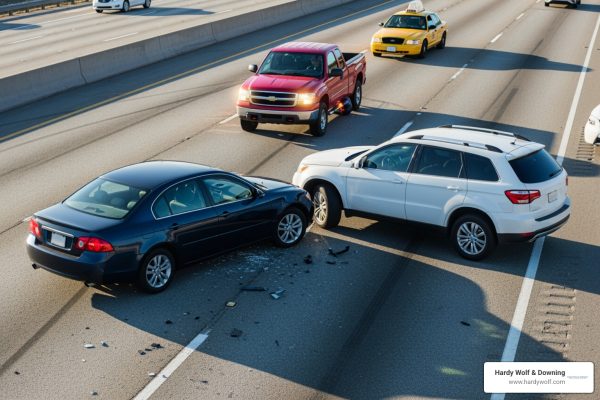
The Silent Threat on Our Roads: Understanding Aggressive Driving Accidents
Last updated on December 18th, 2025 at 11:25 am
An aggressive driving accident happens when a driver acts dangerously, putting others at risk. These accidents are not just minor bumps. They often involve behaviors like speeding, tailgating, or weaving through traffic. This can lead to serious harm.
Here’s why aggressive driving is such a big problem:
- Definition: Aggressive driving means operating a vehicle in a way that endangers people or property.
- Prevalence: Over 55% of fatal crashes involve drivers acting aggressively.
- Fatalities: Speeding, a common aggressive behavior, killed 11,775 people in 2023.
- Severity: Aggressive driving makes crashes much worse, leading to more severe injuries and higher costs.
Many drivers don’t even realize they are driving aggressively. But the impact on victims and their families is very real. This guide will help you understand these dangers and what you can do if you’ve been affected.

Understanding the Dangers of an Aggressive Driving Accident
We all share the road, but when a driver’s urgency outweighs everyone’s safety, tragedy can strike. An aggressive driving accident is the direct result of dangerous choices: speeding, tailgating, or weaving through traffic. These aren’t just bad habits; they turn vehicles into weapons.
At Hardy Wolf & Downing, we’ve seen how these accidents devastate Maine families. The physical, emotional, and financial aftermath can last a lifetime. Understanding the dangers of aggressive driving is the first step toward protecting yourself.
Defining Aggressive Driving vs. Road Rage
People often confuse these terms, but the difference is intent.
Aggressive driving is a traffic offense. The National Highway Traffic Safety Administration (NHTSA) defines aggressive driving as committing multiple traffic violations that endanger others. It’s deliberate, unsafe driving with a disregard for safety. Common examples include:
- Speeding excessively
- Tailgating
- Weaving through traffic
- Running red lights
- Making improper lane changes
- Blocking other drivers
These drivers are impatient and frustrated, not necessarily intending to cause harm, but willing to risk your safety.
Road rage is a criminal offense. It’s when a driver uses their vehicle as a weapon with the intent to harm or intimidate. This can involve chasing, ramming, or physically assaulting another driver. The key difference is that an aggressive driver disregards your safety, while a road-rage driver actively wants to hurt you.
| Feature | Aggressive Driving | Road Rage |
|---|---|---|
| Intent | Disregard for safety, impatience | Intent to harm, intimidate, or threaten |
| Behaviors | Speeding, tailgating, weaving, running lights | Physical assault, ramming, chasing, using vehicle as weapon |
| Legal Standing | Traffic violation, reckless driving | Criminal act, assault, potentially felony |
| Emotional Core | Frustration, impatience | Intense anger, desire for revenge |
| Consequences | Fines, points, increased accident risk | Criminal charges, jail time, severe injury, death |
Understanding this distinction is crucial for your case, as it affects potential charges and the compensation you may receive.
The Alarming Statistics and Causes
The statistics on aggressive driving are frightening. According to AAA, over 55% of fatal crashes involve aggressive driving behaviors. Speeding alone is a major factor, contributing to 29% of all traffic fatalities and killing 11,775 people in 2023. Here in Maine, speeding-related crashes kill roughly 50 people and injure about 8,200 annually.
Why do people drive this way?
- Traffic Congestion: Frustration builds in heavy traffic, leading to risky maneuvers.
- Personal Stress: Drivers often carry stress from their day into the car.
- Anonymity: Feeling disconnected inside a vehicle can make it easier to act out.
- Retaliation: Some drivers react to perceived slights from others on the road.
Speeding doesn’t just increase the chance of a crash; it makes the outcome far worse. Higher speeds reduce reaction time, make steering more difficult, and dramatically increase stopping distance. Most importantly, the force of impact increases exponentially with speed, leading to more violent collisions and devastating injuries. These aren’t just numbers; they are the people we help every day who are rebuilding their lives after an aggressive driving accident.
You can learn more info about the top driving no-nos to avoid dangerous habits. For detailed data, check this source for speeding-related deaths.
Common Injuries and Legal Consequences
When an aggressive driving accident happens, the high-speed, violent impacts often cause catastrophic injuries. Victims commonly suffer from:
- Whiplash and other neck/back injuries
- Traumatic brain injuries (TBIs), from concussions to severe, life-altering brain damage
- Spinal cord injuries, potentially leading to paralysis
- Broken bones, often requiring surgery and long-term rehabilitation
- Internal bleeding and organ damage
- Chronic pain from soft tissue injuries
- Permanent scarring and disfigurement
The medical journey is often long and expensive.
For the aggressive driver, the consequences can be severe. In Maine, this behavior often falls under reckless driving laws. Penalties can include:
- Criminal charges, such as vehicular assault or manslaughter
- Substantial fines and jail time
- License suspension or revocation
- Skyrocketing insurance premiums
Legally, the aggressive driver can be held financially responsible for the harm they caused through a civil lawsuit. This allows victims to seek compensation for their medical bills, lost income, and pain and suffering. In cases of extreme negligence, punitive damages may be sought to punish the driver.
For more information on serious collisions, read about 3 Dangerous Types of Car Accidents.
How to Respond and Protect Yourself
Encountering an aggressive driver is frightening, but your safety is the top priority. Engaging with them is never the answer.
- Stay Calm and Don’t Engage: Their behavior is about them, not you. Avoid eye contact, gestures, honking, or flashing your lights.
- Create Distance: Safely change lanes, slow down, or even pull over to let them pass. Give them plenty of space.
- Keep Yourself Secure: If they try to confront you, keep your windows up and doors locked.
- Call 911 if Threatened: If you are being followed or feel you are in danger, call for help. Provide the vehicle description, license plate, and location. Do not drive home; go to a police station or a busy public area.
You can also prevent becoming an aggressive driver yourself:
- Plan Ahead: Give yourself extra time to avoid rushing.
- Manage Stress: Listen to calming music or a podcast. If you’re upset, pull over for a few minutes.
- Be Forgiving: Assume other drivers’ mistakes aren’t personal. A moment of patience can prevent an aggressive driving accident.
- Drive Courteously: Use turn signals, maintain a safe following distance, and let others merge.
For more helpful strategies, check out these AAA tips on how to avoid aggressive driving.
Your Legal Options After an Aggressive Driving Accident in Maine
When an aggressive driving accident upends your life, the path forward can seem overwhelming. You’re dealing with injuries, mounting bills, and uncertainty about the future. It’s important to know that you have rights. Maine law provides a clear path for victims to hold reckless drivers accountable and recover the compensation they need to heal. At Hardy Wolf & Downing, we believe every victim deserves an advocate who will fight for their recovery. The legal process exists to protect people like you, ensuring you can get the care you need and rebuild your life without the added burden of financial ruin.

Proving Fault in an Aggressive Driving Accident Case
To build a strong case, we must prove the other driver’s aggressive actions caused your injuries. This requires gathering key evidence:
- Police Report: This official document notes traffic violations like speeding or running a red light, providing a crucial foundation for your case.
- Witness Testimony: Statements from other drivers or pedestrians who saw the aggressive behavior can be incredibly persuasive.
- Video Footage: Dashcam or traffic camera footage provides indisputable, real-time proof of what happened.
- Accident Reconstruction Experts: For complex crashes, specialists can analyze physical evidence to scientifically demonstrate how the driver’s aggression caused the collision.
The core of the case is proving negligence. Every driver has a duty to operate their vehicle safely. Aggressive driving is a clear breach of that duty. When we connect that breach directly to your injuries, we establish the other driver’s liability. It’s vital to gather this evidence quickly, as it can disappear over time.
How to Build a Personal Injury Case with Evidence offers more insights into this process.
Seeking Compensation and Justice in Maine
After an aggressive driving accident, Maine law allows you to seek compensation for the full range of your losses. This includes:
- Medical Expenses: All costs from the ambulance ride to future rehabilitation and long-term care.
- Lost Wages and Earning Capacity: Compensation for missed paychecks and any impact on your future ability to earn a living.
- Pain and Suffering: Acknowledges the physical pain and emotional distress caused by the accident and your injuries.
- Loss of Enjoyment of Life: For the inability to participate in hobbies and activities you once loved.
- Permanent Scarring or Disfigurement.
In Maine, the statute of limitations generally gives you six years from the accident date to file a lawsuit. While this seems like a long time, building a strong case requires immediate action.
This is where Hardy Wolf & Downing can make a critical difference. We handle the entire legal process, from gathering evidence and dealing with insurance companies to fighting for you in court if necessary. We know the tactics insurers use to minimize payouts, and we prepare every case for trial to maximize your leverage in settlement negotiations. You focus on healing; we’ll handle the fight for justice.
If an aggressive driving accident has impacted your life, you don’t have to face it alone. We’re here to help you understand your options and pursue the full compensation you deserve.
Learn about your legal options after a serious collision to understand how we can help you begin rebuilding your life. We offer free consultations, and we’re ready to listen to your story.