
What Insurance Companies Don’t Want You to Know About Your Claim
How car accident lawyers increase claim value is one of the most important questions you can ask after a crash in Maine — and the answer can mean the difference between a lowball payout and a settlement that actually covers your losses.
Here’s the short answer:
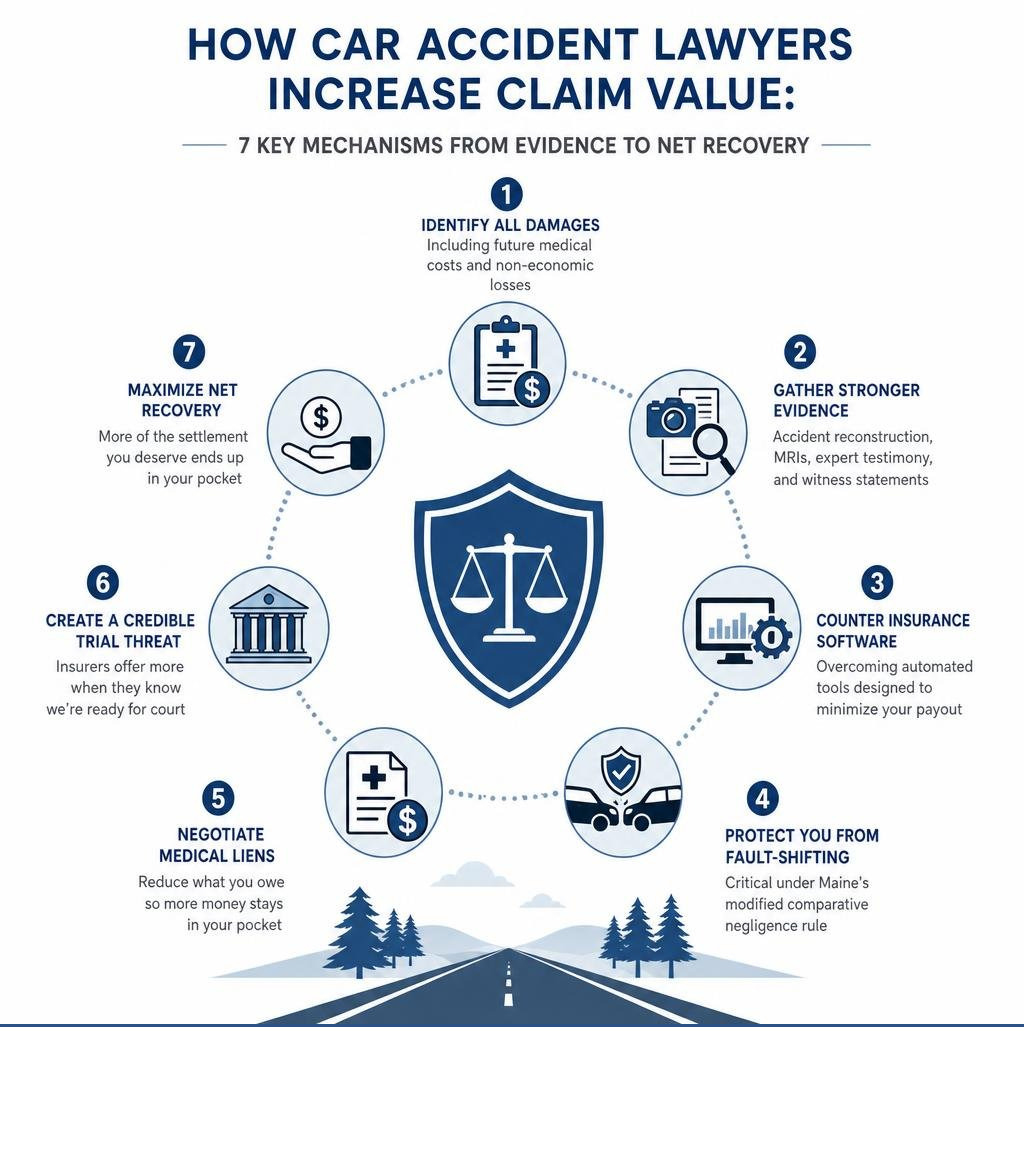
Car accident lawyers increase claim value by:
- Identifying all damages — including future medical costs and non-economic losses that insurers routinely ignore
- Gathering stronger evidence — accident reconstruction, MRIs, expert testimony, and witness statements
- Countering insurance software — overcoming automated tools like Colossus that are designed to minimize your payout
- Protecting you from fault-shifting — especially critical under Maine’s modified comparative negligence rule, where being found 50% or more at fault means you recover nothing
- Negotiating medical liens — reducing what you owe back to health insurers so more money stays in your pocket
- Creating a credible trial threat — insurers offer more when they know your attorney will take the case to court
The data is clear. A Martindale-Nolo survey found that injury victims represented by an attorney received a median settlement of $77,600 — compared to just $17,600 for those without representation. That’s a 4.4x difference in gross settlement value.
After a crash on a Portland highway or a Lewiston intersection, an insurance adjuster may call you within days — sometimes hours. Their job is to settle your claim fast and cheap, before you understand the full extent of your injuries or your legal rights.
Most people don’t realize that the first offer is almost never a fair one. Initial offers are typically 30 to 50% below what a claim is actually worth. Without legal representation, most injured people simply don’t know what they’re leaving on the table.
This guide breaks down exactly how experienced Maine car accident attorneys — like the team at Hardy Wolf & Downing — work to protect and maximize the value of your claim at every stage of the process.
How Car Accident Lawyers Increase Claim Value
To understand how an attorney maximizes your payout, you first have to understand how a claim is valued. Many unrepresented victims look only at their immediate out-of-pocket expenses. This is a costly mistake.
In Maine, a comprehensive personal injury claim is built on two primary types of compensatory damages:
- Economic Damages: These are the quantifiable financial losses you can prove with receipts, bills, and pay stubs. They include your past and future medical bills, rehabilitative therapy, lost wages, diminished earning capacity, and property damage.
- Non-Economic Damages: These represent the human cost of the accident. They include physical pain and suffering, emotional distress, loss of enjoyment of life, and loss of consortium.
When you negotiate without an attorney, insurance adjusters use high-pressure tactics to get you to sign a release early. They know that once you sign, your case is closed forever. If you discover three months from now that you need spinal surgery, you cannot go back and ask for more money.
By analyzing the full scope of your injuries, an attorney ensures that both immediate and long-term damages are accounted for. This is why hiring a lawyer will actually increase my settlement amount. is a resounding yes for most injured victims. Attorneys know how to estimate future medical costs and lost earnings, helping you avoid accepting a quick settlement that leaves you financially stranded. For a deeper look at maximizing your recovery, read our guide on how do I get the most money from a car accident?.
Understanding the Car Accident Settlement Formula and Insurance Software
If you think a human being is carefully reading your medical records and feeling empathy for your situation, think again. Today, major auto insurance carriers use automated claims evaluation software, most notably a program called Colossus, to value claims.
Colossus is designed to do one thing: commoditize human suffering and minimize payouts.
The software works by converting your injuries into data points. The adjuster inputs specific ICD (International Classification of Diseases) codes from your medical records. Colossus then calculates a “value range” based on regional historical data and the specific inputs.
However, Colossus has major limitations that insurers weaponize against you:
- The “Treatment Gap” Penalty: If you waited several days to see a doctor after a crash on I-95, or if you missed a physical therapy appointment, the software automatically flags a “treatment gap” and slashes your claim’s value.
- Ignoring Non-Economic Nuances: Colossus cannot read a journal entry about how you can no longer pick up your child or sleep through the night due to chronic back pain. It only reads billing codes.
An experienced lawyer knows how to “feed” the software the precise, structured medical documentation it requires, while simultaneously building a narrative that bypasses the algorithm. If the insurance company claims you should receive less, your attorney can show them the cold, hard reality of what actually happened. Learn more about how to handle these situations in our article The insurance company said I’d get less money with a lawyer – here’s what actually happened.
How Car Accident Lawyers Increase Claim Value Through Evidence and Expert Testimony
To beat the insurance software and secure a high-value settlement, you need irrefutable evidence. This is where an attorney’s resources make a massive difference.
On Maine’s complex roads — whether dealing with winter ice in Augusta or heavy tourist traffic in Portland — proving liability can be incredibly difficult. A lawyer will immediately work to preserve time-sensitive evidence, including:
- Accident Reconstruction: Partnering with forensic reconstruction experts to analyze skid marks, vehicle damage, and black box data to prove exactly how the crash occurred.
- Advanced Diagnostic Imaging: Insurers love to dismiss back and neck pain as “soft tissue injuries” that should heal in a few weeks. Your attorney will work with your treating physicians to secure advanced imaging like MRIs or CT scans, which can objectively prove disc herniations or traumatic brain injuries (TBIs).
- Expert Witness Testimony: Utilizing vocational experts, economists, and medical specialists to project your lifelong care needs and lost earning capacity.
Establishing these facts early prevents the insurer from devaluing your claim. For actionable steps to build your case, check out 5 ways to increase the settlement value of your personal injury claim.
How Car Accident Lawyers Increase Claim Value by Negotiating Medical Liens
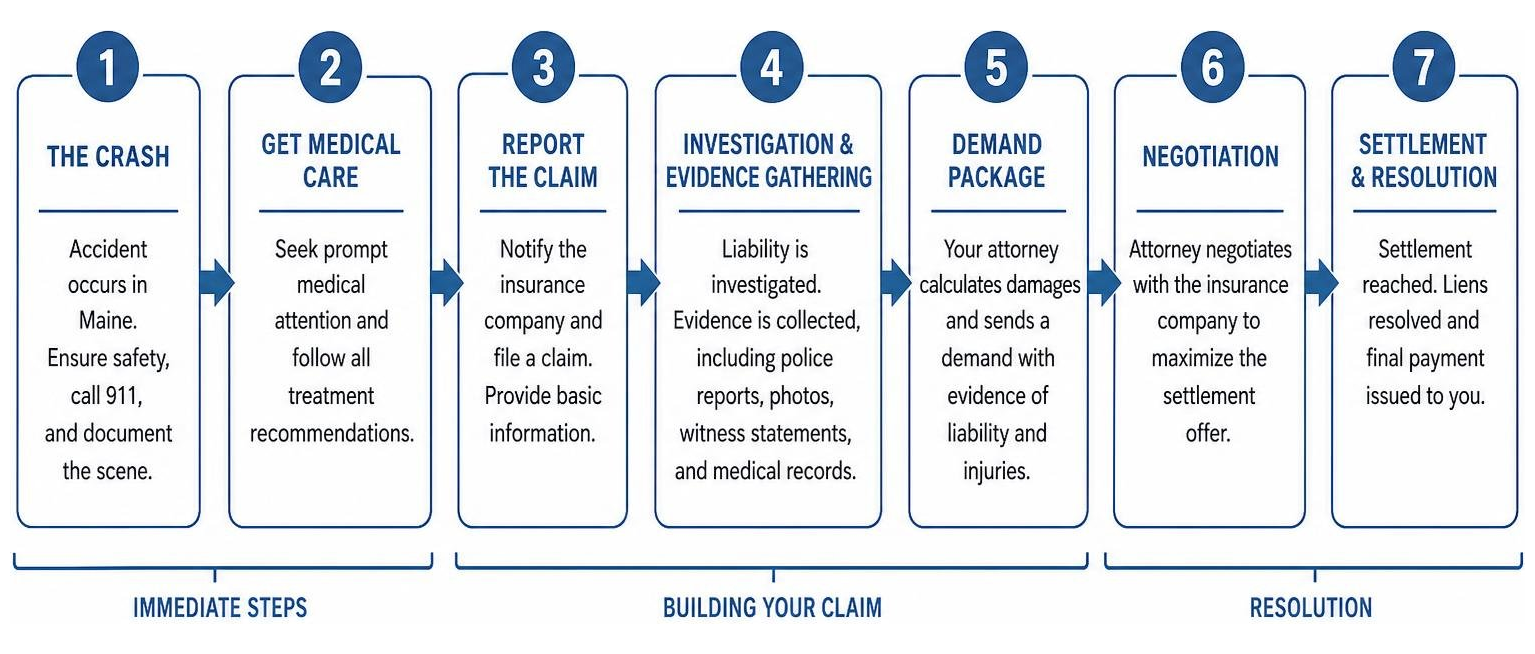
Many people believe that the gross settlement check is the only number that matters. In reality, the only number that impacts your life is your net recovery — the amount of money that actually lands in your bank account after everyone else is paid.
When you receive a settlement, your health insurance provider (whether private insurance, MaineCare, or Medicare) will likely assert a medical lien or subrogation claim. They want to be paid back for the medical treatments they covered after your accident.
If you are unrepresented, these companies will demand 100% of the value of their lien, which can easily wipe out your entire settlement.
A skilled personal injury attorney will aggressively negotiate these liens down. It is common for experienced lawyers to secure reductions of 20% to 50% on medical liens. By lowering what you owe to third parties, your attorney directly increases the cash that goes home with you. Discover more about keeping more of your settlement in our guide on how do I get the most out of my personal injury claim?.
Navigating Maine’s Modified Comparative Negligence and Legal Deadlines
Every state has its own unique legal framework governing car accidents. If you do not understand Maine’s specific statutes and rules, you risk losing your right to compensation entirely.
- Maine’s General Statute of Limitations: In Maine, you generally have six (6) years from the date of the car accident to file a personal injury lawsuit. While this is one of the most generous statutes of limitations in the country, waiting is highly dangerous. Evidence disappears, witness memories fade, and physical therapy records can be lost.
- Claims Against Government Entities: If your crash involved a government-owned vehicle (such as a state plow or a city bus in Portland or Lewiston), you must comply with the Maine Tort Claims Act. This requires you to file a formal written notice of claim within 365 days of the injury and to commence a lawsuit within 2 years.
Navigating these strict timelines requires local expertise. For a detailed breakdown of Maine-specific legal procedures, read ” How to Increase Settlement Value in a Personal Injury Claim in Maine.
How Maine’s 50% Fault Rule Affects Your Settlement Amount
Maine operates under a modified comparative negligence standard, specifically a “50% bar rule.”
Under this law, an injured party can only recover damages if their fault is less than 50%. If a jury or an insurance adjuster determines that you are 50% or more at fault for the accident, you recover absolutely nothing.
Furthermore, if you are found partially at fault (for example, 20% responsible because you were traveling slightly over the speed limit when another driver pulled out in front of you), your compensation is affected. Legally, your compensation is reduced by an amount that reflects your negligence — not by a simple, flat percentage.
Insurance adjusters are experts at exploiting this rule. They will take your recorded statements out of context, analyze minor details of the crash, and attempt to shift the blame onto you to save their company money. An experienced Maine lawyer acts as a shield, gathering the necessary evidence to prove the other driver’s liability and protecting you from unfair blame-shifting. If you are questioning whether you need representation for a clear-cut crash, read ” Should I get a lawyer for a car accident that wasn’t my fault?.
Frequently Asked Questions About Maine Auto Injury Settlements
What is the average car accident settlement in Maine?
There is no true “average” car accident settlement. Every case is unique and depends on specific factors, including the severity of your physical injuries, the total cost of your medical bills, whether you have permanent impairment, and the limits of the available insurance policies. A minor whiplash claim may settle for a few thousand dollars, while a catastrophic crash causing a disabling spine or brain injury can result in a six- or seven-figure recovery.
What happens if the at-fault driver doesn’t have insurance or has insufficient policy limits?
If you are hit by an uninsured or underinsured motorist, you can seek compensation through the Uninsured/Underinsured Motorist (UM/UIM) coverage on your own auto insurance policy. In Maine, this coverage is mandatory. Your attorney can help you navigate this process, which can be surprisingly adversarial, as your own insurance company will try to minimize your payout just like a third-party insurer would. For more information, read our article what happens if someone hits me and doesn’t have insurance?.
How long does it take to resolve a car accident claim in Maine?
The timeline varies significantly. A straightforward claim with clear liability and minor injuries might resolve in three to six months. However, complex claims involving severe, ongoing medical treatments should never be settled quickly. It is critical to wait until you reach Maximum Medical Improvement (MMI) — the point at which your doctors believe your condition has stabilized — before negotiating. Settling earlier means you risk leaving future medical expenses completely unpaid.
Partner with Hardy Wolf & Downing to Secure Your Recovery
When you are recovering from a serious physical injury, the last thing you should have to worry about is fighting aggressive insurance adjusters who are actively working to devalue your claim.
At Hardy Wolf & Downing, we have spent decades fighting for the rights of injured Mainers. Serving Portland, Lewiston, Bangor, and communities across the state, our experienced trial attorneys understand the local courts, the local roads, and the tactics that insurance companies use to avoid paying fair settlements.
We believe that every injured person deserves top-tier legal representation. That is why we work on a no-risk contingency fee basis. You pay us absolutely nothing upfront, and we only get paid if we successfully secure compensation for you.
If you want to protect your financial future and focus on your physical healing, let our team handle the insurance companies for you. To learn more about how we can help, read about the benefits of hiring an experienced personal injury attorney and discover why you shouldn’t represent yourself in a personal injury claim.
Ready to take the next step? Contact the team at Hardy Wolf & Downing Auto Accident Representation today for a free, confidential case evaluation.