


Why a Brain and Spine Injury Changes Everything
A lawyer who is experienced in brain and spine injury cases helps people who have suffered catastrophic injuries caused by someone else’s negligence recover compensation for medical expenses, lost income, and lifelong care needs.
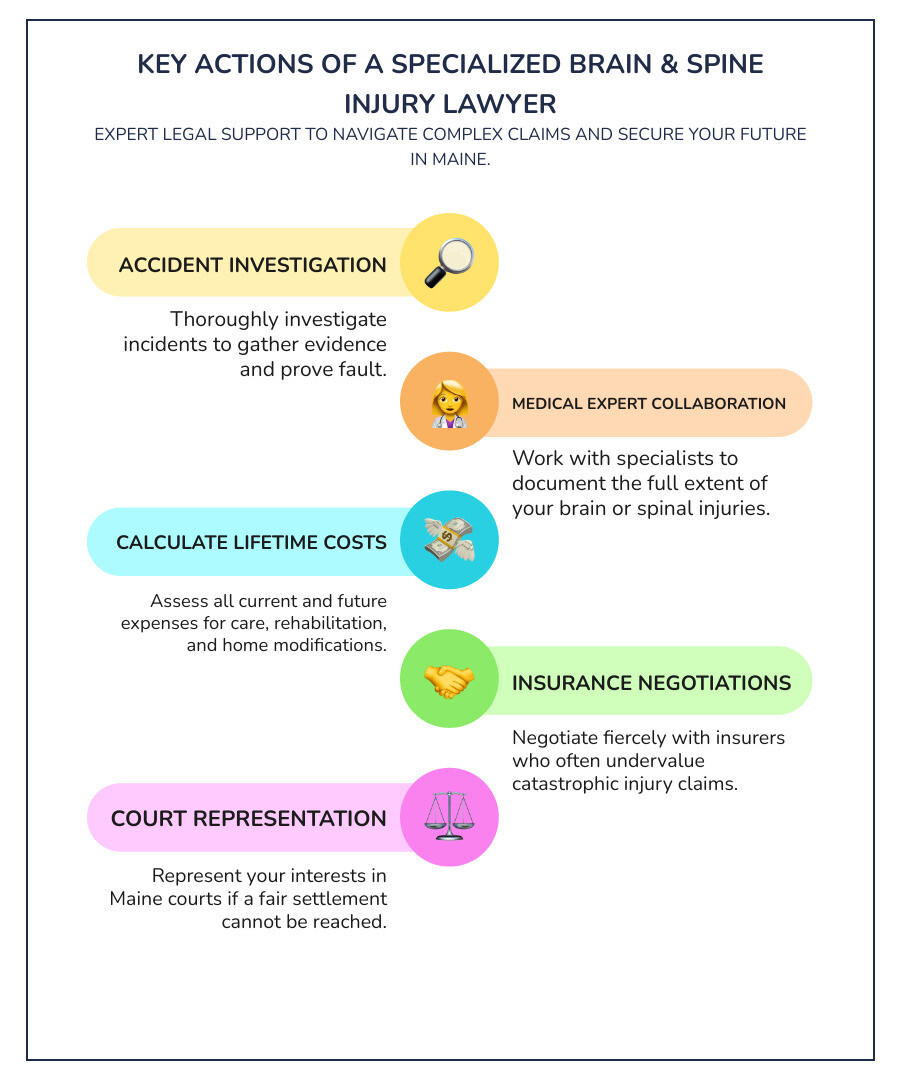
What they do:
- Investigate the accident and gather evidence to prove fault
- Work with medical experts to document the full extent of your injury
- Calculate present and future costs, including rehabilitation and home modifications
- Negotiate with insurance companies, which often undervalue complex claims
- Represent you in Maine courts if a fair settlement cannot be reached
Why you need one:
In Maine, traumatic brain injuries (TBI) and spinal cord injuries (SCI) are life-altering events that demand specialized legal knowledge of state law and the medical knowledge to win your case. Proving long-term costs, lost earning capacity, and changes in quality of life requires expert testimony and a deep understanding of Maine’s specific personal injury laws.
Insurance companies count on victims not understanding the true value of their claim. If you’ve suffered an injury in Portland, Lewiston, or anywhere in Maine, you’re facing questions about your recovery and financial stability. Maine law gives you a limited window to pursue justice. Understanding your rights is the first step toward reclaiming your life.
Why You Need a Specialized Brain and Spine Injury Lawyer in Maine
Suffering a traumatic brain injury (TBI) or spinal cord injury (SCI) fundamentally alters a person’s life, impacting mobility, cognition, and financial stability. A specialized brain and spine injury lawyer in Maine is essential because they understand the medical and financial complexities of catastrophic impairment.
Proving Negligence and Liability in Maine
At the heart of these cases is negligence—when another party’s carelessness causes an accident. Proving negligence in Maine requires establishing that the at-fault party owed you a duty of care, breached that duty, and directly caused your injuries. This involves a meticulous investigation that gathers accident reports, witness statements, and surveillance footage. For example, in a Portland car accident, your attorney must prove the other driver failed to act as a reasonably careful person to secure compensation for your TBI or SCI.
The Critical Role of Medical Experts
TBIs and SCIs are complex. Brain injuries may not show symptoms immediately, and spinal cord injuries can lead to varying degrees of paralysis. A specialized lawyer works with a team of medical experts, including neurologists and rehabilitation specialists, to:
- Accurately diagnose the full extent of your injuries.
- Project future medical needs and potential complications.
- Explain the technical mechanisms of your injury to a jury.
- Document the impact on your daily functioning.
Without this collaboration, it is nearly impossible to convey the long-term consequences to an insurance company. For more details, visit our page on Spinal Cord Injury Types.
Navigating Insurance and Long-Term Costs
Insurance companies often offer quick settlements that underestimate the true cost of care. In Maine, a patient with a severe cervical spine injury can face costs exceeding $1 million in the first year alone, making a comprehensive legal claim vital. A skilled lawyer handles all communication with adjusters and negotiates aggressively to cover all past, present, and future needs. For more information on our services, visit: More info about spine injury services. To understand the medical gravity of these cases in Maine, see the Scientific research on TBI statistics.

Navigating the Complexities of a Claim
A ‘holistic law approach’ considers your overall physical, mental, and financial health. This ensures the legal strategy supports your comprehensive long-term needs, helping you ‘live a life, not a claim.’
Understanding Lifetime Expenses
Ongoing expenses often include rehabilitation, home modifications, specialized vehicles, and lost earning capacity. A thorough legal team works with life care planners and economists to project these costs over your lifetime.
Differences Between TBI Severities
There is “no such thing as a ‘mild’ brain injury.” Even a concussion can have lasting impacts.
| TBI Severity | Characteristics & Symptoms | Long-term Effects |
|---|---|---|
| Mild TBI (Concussion) | Brief loss of consciousness or altered mental state. Headache, confusion, memory problems. | Can lead to post-concussion syndrome (PCS) with persistent cognitive issues. |
| Moderate TBI | Loss of consciousness for minutes to hours. Slurred speech, profound confusion, mood swings. | Challenges with information processing and emotional regulation. |
| Severe TBI | Prolonged unconsciousness or coma. Profound cognitive and physical disability. | Often results in permanent disability requiring 24/7 care. |
Maine Statute of Limitations
Maine has strict deadlines for filing claims. Generally, you have six years, but this is shorter for specific cases:
- Medical Malpractice: Three years.
- Ski Resorts: Two years.
- Government Entities: Formal notice that complies with Maine law must be served within one year.
Missing these deadlines ends your right to compensation in most cases. For more, visit: More info about TBI claims.
Proving Damages with Expert Testimony
Your attorney will engage specialists to paint a complete picture for the court:
- Life Care Planners: Detail the costs of lifelong care.
- Vocational Experts: Assess lost earning capacity.
- Economists: Quantify financial impact.
We seek both Economic Damages (medical bills, lost wages) and Non-Economic Losses (pain and suffering, loss of enjoyment of life). The financial burden of these injuries is immense, and Maine law provides a framework for victims to recover these significant lifetime costs. For choosing the right advocate, see More info about choosing a spine injury lawyer.
Choosing the Right Legal Path for Your Recovery in Maine
Selecting legal representation is a critical decision. You need a team that understands catastrophic injuries and Maine’s specific legal landscape.
Contingency Fees and Trial Experience
Most Maine brain and spine injury lawyers work on a contingency basis, meaning you pay no upfront fees and only pay if they recover compensation for you. Furthermore, trial experience is paramount. Insurance companies offer better settlements when they know your attorney is prepared to present complex medical evidence to a jury.
Local Authority and Maine-Specific Knowledge
A firm with offices in Portland and Lewiston, which practices around the state, understands local judges, Maine statutes, and local medical resources. This knowledge is crucial for building trust and ensuring your case is handled correctly. For info on advances in recovery, see Maine Accident Attorneys Applaud Advances in Spinal Trauma Rehabilitation.
Maine’s Legal Realities: Comparative Negligence
Maine follows a “51% bar rule” for comparative negligence. If you are 51% or more at fault for an accident, you cannot recover damages. If you are less than 51% at fault, your compensation is reduced by your percentage of fault. Insurance adjusters often try to shift blame to you; an experienced lawyer protects you from these tactics. Never sign documents or accept offers without legal review. For insights on successful outcomes, see Hardy Wolf Downing Settles Traumatic Brain Injury Lawsuit.
Frequently Asked Questions
“Do I need a lawyer for my brain or spinal cord injury case?” Yes. These cases are too complex to handle alone due to the medical evidence required and the high value of long-term damages.
“What is my case worth?” Value depends on injury severity, impact on your life, and liability. We work with experts to determine a fair value for your past and future needs.
“How long do I have to file a lawsuit in Maine?” Generally, six years, but medical malpractice (3 years) and claims against government entities (1-2 years) have much shorter windows.
“What if I was partly at fault?” As long as you are less than 51% at fault, you can still recover compensation, though it will be reduced by your percentage of responsibility.
For info on recognizing symptoms such as nerve compression, see “More info about lumbosacral nerve root compression.”
Key Takeaways
- Specialization is Key: Catastrophic injuries require specific legal and medical expertise.
- Local Roots: Hardy Wolf & Downing provides deep Maine-specific knowledge from offices in Portland and Lewiston.
- Financial Security: We calculate lifetime costs to ensure you aren’t left with unpaid medical bills.
- Act Fast: Maine’s statutes of limitations are strict.
If you’re unsure whether you have a case, a short conversation with a Maine injury attorney can help. To learn more, visit More info about Maine spinal cord injury claims.

