

Why So Many Riders Get Hurt: The Real Causes Behind Motorcycle Crashes
How do motorcycle crashes happen is one of the most important questions any rider — or injured rider’s family — can ask. Here’s a quick answer:
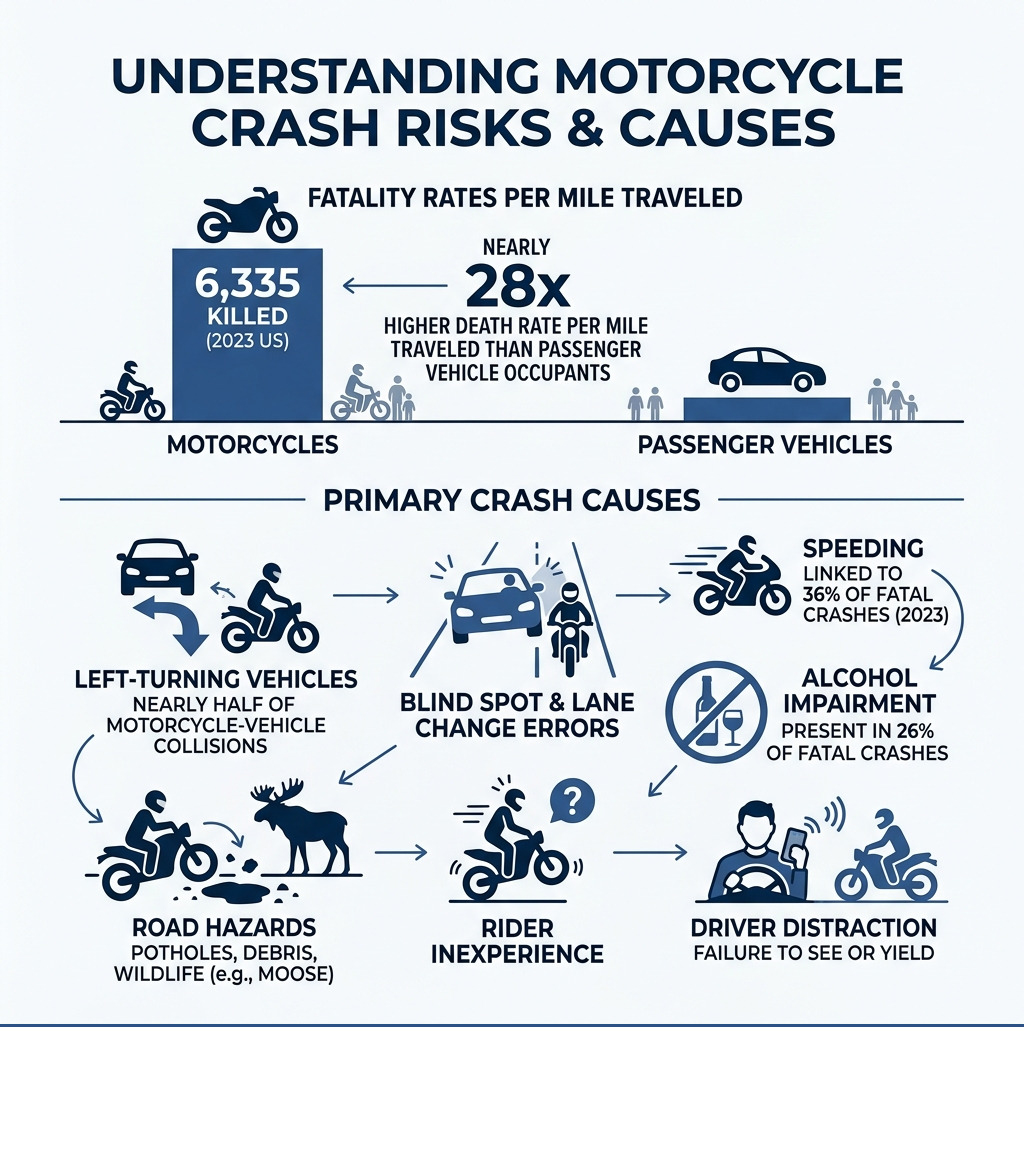
The most common causes of motorcycle crashes:
- Left-turning vehicles at intersections (nearly half of all motorcycle-vehicle collisions).
- Blind spot and lane change errors by other drivers.
- Speeding (linked to 36% of fatal motorcycle crashes in 2023).
- Alcohol impairment (present in 26% of fatal crashes, and 40% in single-vehicle crashes).
- Road hazards — potholes, debris, wet surfaces, and in Maine, wildlife.
- Rider inexperience or riding without a valid motorcycle license or appropriate training.
- Driver distraction — failure to see or yield to motorcyclists.
Motorcycles offer almost no protection in a crash. There are no airbags, no steel frame around you, no crumple zones. That physical reality is what makes motorcycle accidents so devastating.
The numbers reflect it. In 2023, 6,335 motorcyclists were killed across the U.S. — the highest number ever recorded. Per mile traveled, motorcyclists are nearly 28 times more likely to die in a crash than passenger car occupants.
In Maine, the risks are real and growing. Fatalities rose to 35 in 2024, up from just 16 in 2023. The state’s winding rural roads, short riding season, and wildlife hazards — including moose — create dangers that riders elsewhere simply don’t face.
Most crashes aren’t random bad luck. They follow predictable patterns. And understanding those patterns is the first step — whether you’re trying to stay safe, or trying to understand what happened after a serious accident.
How Do Many Motorcycle Crashes Happen in Maine?
When we look at the data for cities like Portland, Lewiston, and Bangor, a clear pattern emerges: most motorcycle accidents are not caused by the rider “taking a risk,” but by the failure of other motorists to share the road safely. According to the Motorcycle Crash Causation Study: Final Report, human error is the primary factor in the vast majority of these incidents.
In Maine, our riding season is concentrated into a few short, beautiful months. This means drivers often “forget” how to look for motorcycles after a long winter. When drivers fail to scan their environment properly, they violate a motorcyclist’s right-of-way. Whether it is a distracted driver on Congress Street in Portland or someone rushing through a rural intersection in York, the result is often a high-impact collision that leaves the rider with life-altering injuries.
Left-Turn Collisions: How Do Many Motorcycle Crashes Happen at Intersections?
Intersections are the most dangerous places for any Maine rider. Statistics show that 35% to 45% of all motorcycle crashes occur at intersections, and the most common scenario is a vehicle turning left in front of a motorcycle traveling straight.
Why does this happen so frequently? Scientists point to the “size-arrival illusion.” Because motorcycles are smaller than cars, the human brain often misjudges their distance and speed. A driver waiting to turn left might see the motorcycle but incorrectly assume they have plenty of time to clear the turn.
The List of findings in the Hurt Report remains a cornerstone of understanding this issue. It notes that the “predominating cause” of multi-vehicle accidents is the failure of motorists to detect and recognize motorcycles in traffic. Drivers often claim they “never saw the bike,” a phenomenon known as a visual scanning error.
Blind Spots and Lane Change Accidents
Because of their slim profile, motorcycles easily disappear into the blind spots of passenger vehicles. Modern cars, while safer for their occupants, often have thick pillars that further obscure a driver’s view. When a driver fails to physically turn their head and check their blind spot before merging on I-295, the motorcyclist next to them is in immediate peril.
In Maine, “lane splitting”—the practice of riding between lanes of slow-moving traffic—is illegal. While common in some other states, attempting this in Maine significantly increases the risk of a side-swipe or “door-opening” accident. Understanding The Hidden Dangers Of Motorcycle Blind Spots Protecting Yourself And Your Rights is essential for every rider. Even if you are riding perfectly within your lane, a driver’s “inattentional blindness” can lead them to move directly into your path.
Maine-Specific Hazards: Wildlife and Road Conditions
Maine riders face unique environmental challenges that aren’t as prevalent in southern or more urban states. Our wildlife is a major factor. A moose or deer jumping into the road is a hazard for a car, but for a motorcycle, it is almost always catastrophic. In fact, a Local Motorcyclist Survives Crash Caused By Maine Wildlife is often considered a miracle given the size and weight of these animals.
Road conditions also play a massive role. After a Maine winter, our roads are often littered with:
- Potholes: Deep enough to throw a rider from their bike or cause a tire blowout.
- Sand and Gravel: Leftover from winter road treatments, these act like ball bearings under a motorcycle’s tires, especially in corners.
- Expansion Joints: On bridges in places like Bath or Brunswick, these can become incredibly slick when wet.
Speeding and Impairment Risks
While driver negligence is a leading cause, rider-related factors like speeding and alcohol also contribute to the statistics. Speeding reduces the amount of time a rider has to react to a driver’s mistake. In 2023, 36% of fatal motorcycle crashes involved speeding.
Alcohol impairment remains a deadly issue. Nationally, 26% of fatally injured motorcycle drivers had a BAC at or above the legal limit of 0.08%. This number jumps to 40% in single-vehicle crashes, where a rider might lose control on a curve. Following the advice in 5 Things Not To Do On A Motorcycle—which includes never riding while impaired—is the best way to ensure you make it home after a weekend ride.
Protecting Your Rights After a Maine Motorcycle Accident
If the worst happens and you are involved in a crash, the legal road ahead can be just as complex as the physical recovery. At Hardy Wolf & Downing, we have seen how insurance companies try to shift the blame onto motorcyclists, relying on unfair stereotypes about “reckless riders.”
In Maine, you have a 6-year statute of limitations for most personal injury claims, while wrongful death and alcohol related claims are much shorter. However, if your accident involved a government vehicle or a dangerous road condition maintained by a public entity, you must file a formal written notice of claim within 365 days. Waiting too long can permanently bar you from seeking the compensation you need for medical bills, lost wages, and pain and suffering.
Modified Comparative Negligence: How Do Many Motorcycle Crashes Happen and Impact Recovery?
Maine follows a modified comparative negligence rule. This is a critical concept to understand if you are wondering how do many motorcycle crashes happen and how that affects your legal case.
Under this rule, you can only recover damages if your fault is less than 50%. If a jury determines you were 50% or more at fault, you receive nothing. If you are found to be partially at fault, your total compensation is reduced by an amount reflecting negligence, not a percentage. Because insurance adjusters often try to push as much “fault” onto the rider as possible, having an experienced attorney to prove the other driver’s negligence is vital. For more details, you can review our Maine Motorcycle Accident Faq.
Road Hazards and Liability Standards
When accidents are caused by road conditions or property hazards, specific Maine standards apply. For premises liability, property owners owe a duty of care to any non-trespasser. Additionally, if construction is involved, contractors have no independent duty to the public unless they created the problem. Whether it’s a vehicle rollover or a collision caused by debris, identifying the correct liable party is essential.
Immediate Steps for Legal Protection
The moments following a crash are chaotic, but the steps taken then can make or break a future claim.
- Call 911: Always report the accident. In Maine, you are legally required to report accidents involving injury or significant property damage.
- Seek Medical Attention: Adrenaline masks pain. Many internal injuries or concussions don’t show symptoms immediately.
- Gather Evidence: If you are physically able, take photos of the vehicles, the road conditions, and any skid marks. Record witness names and numbers, DO NOT rely on police for this.
- Avoid Social Media: Insurance companies monitor these platforms to find any reason to diminish your injury claim.
Knowing How To File A Motorcycle Accident Claim starts with professional guidance. Whether your accident happened in Lewiston, Auburn, or a rural stretch of York County, the team at Hardy Wolf & Downing is here to help you navigate the process.
Summary and Key Takeaways
- Visibility is the #1 Issue: Most multi-vehicle crashes happen because a driver failed to see the motorcycle or misjudged its speed.
- Intersections are High-Risk: Left-turning vehicles are the single greatest threat to riders.
- Maine Hazards are Unique: Wildlife (moose/deer) and poor road surfaces (sand/potholes) are major contributors to single-vehicle accidents.
- Legal Deadlines Matter: You generally have 6 years to file. These deadlines are much shorter in wrongful death or alcohol related claims and only 365 days if a government entity is involved.
- Fault Rules are Strict: In Maine, if you are 50% or more at fault, you cannot recover any compensation. Compensation is reduced by an amount reflecting negligence, not a percentage.
FAQ: Common Questions About Maine Motorcycle Accidents
1. What if I wasn’t wearing a helmet at the time of the crash? Maine law only requires helmets for riders under 18, those operating with a learner’s permit, or those within their first year of licensure. If you are a legal adult and choose not to wear one, it does not bar you from filing a claim, though the defense may try to use it to argue about the severity of certain injuries.
2. A driver turned left in front of me, but I didn’t actually hit them—I “laid the bike down” to avoid them. Can I still file a claim? Yes. These are often called “no-contact” accidents. If the driver’s negligence forced you to take emergency action that resulted in a crash, they can still be held liable for your injuries.
3. How much is my motorcycle accident case worth? Every case is different. Compensation typically covers medical expenses (past and future), lost wages, loss of earning capacity, permanent impairment, and pain and suffering. A lawyer can help calculate these damages based on Maine’s specific legal standards.
4. The insurance company offered me a settlement right away. Should I take it? Almost never. Early offers are usually “lowball” settlements designed to close the case before the full extent of your injuries—and the long-term costs of care—are known. Always consult with a Maine trial attorney before signing anything.
If you or a loved one has been injured on Maine’s roads, contact Hardy Wolf & Downing today. Our offices in Portland and Lewiston serve clients throughout the state, from Augusta to Waterville and beyond. We offer a free consultation to help you understand your rights and start the process of reclaiming your life.

