

What a Maine Bus Accident Lawyer Can Do for You Right Now
If you were hurt in a bus crash anywhere in Maine, a Maine bus accident lawyer can protect your rights, deal with insurers on your behalf, and help you pursue the compensation you deserve.
Here is what you need to know right away:
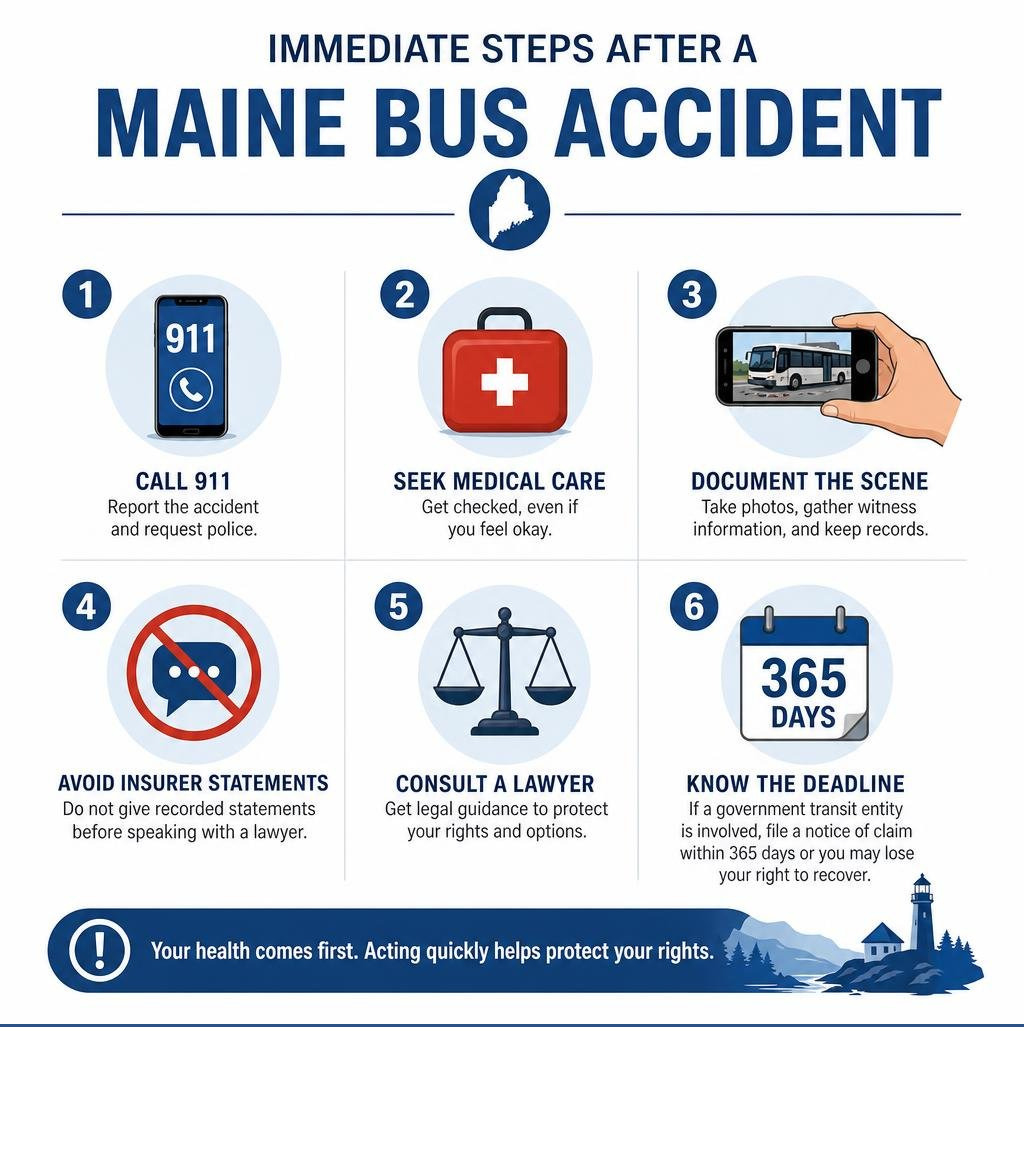
- Get medical care. Even if you feel fine initially, some injuries show up days later.
- Report the accident. Call 911 and make sure a police report is filed.
- Do not give a recorded statement to any insurance company before talking to a lawyer.
- Preserve evidence. Take photos, collect witness names, and keep all medical records.
- Know your deadline. In Maine, you generally have 6 years to file a personal injury claim — but if a government transit entity or other governmental entity is involved, you must file a formal written notice of claim within 365 days of the injury or you may lose your right to recover.
Bus accidents are not like typical car crashes. Buses are large, heavily regulated vehicles. The legal process for pursuing a claim — especially against a public transit operator — is more complex and time-sensitive than most people expect.
If you or someone you love was hurt on a bus in Portland, Lewiston, Augusta, Waterville, Auburn, or anywhere else in Maine, understanding your options quickly matters.
Why You Need a Bus Accident Lawyer
Bus companies and transit authorities operate under a unique set of laws. Under Maine law, buses are classified as “common carriers.” This means they owe their passengers a heightened duty of care—the highest standard of diligence and safety. When a driver or operator breaches this duty, the resulting injuries can be catastrophic.
Because buses are large commercial vehicles, an accident often involves multiple parties, including:
- The bus driver
- Private bus companies (such as charter or tour operators)
- Public transit agencies (like Kennebec Valley Transit)
- Third-party contractors or maintenance providers
Dealing with the insurance companies representing these entities is notoriously difficult. Insurers are focused on minimizing their liability and protecting their bottom line. An experienced Maine bus accident lawyer understands these tactics and handles all communications and negotiations on your behalf. If you want to learn more about how specialized representation handles these commercial claims, you can read about Bus Accidents and how they differ from standard passenger vehicle crashes.
Having local legal counsel who understands the specific local dynamics of Maine courts is critical to protecting your rights and securing fair compensation.
How a Maine Bus Accident Lawyer Proves Liability
Proving negligence in a bus crash requires a thorough, immediate investigation. Unlike standard car accidents, a commercial bus crash generates specialized evidence that must be legally preserved before it is lost or destroyed.
To build a strong case, a personal injury lawyer will look at:
- Driver Logs and Qualifications: Commercial drivers must adhere to strict Federal Motor Carrier Safety Administration (FMCSA) hours-of-service regulations to prevent fatigued driving.
- Maintenance Records: Bus operators must regularly inspect and maintain their vehicles.
- The “Black Box” (Event Data Recorder): This device records speed, braking, and steering inputs leading up to the collision.
- Accident Reconstruction: Working with forensic experts to recreate the crash scene.
It is also important to note how Maine’s laws handle third-party liability. For example, contractor liability in Maine is highly specific: contractors have no independent duty to the public unless they created the problem. This makes identifying the correct liable party essential. You can read more about these complexities in our guides on Protecting Your Rights After a Truck Accident and Truck Trouble: Navigating Injuries After a Commercial Vehicle Crash.
Common Causes and Injuries in Maine Bus Crashes
Buses lack basic safety features like seatbelts and airbags for passengers, meaning even a low-speed collision can lead to severe harm. Common causes of bus crashes in Maine include:
- Distracted driving or driver fatigue
- Speeding and reckless driving on narrow or icy Maine roads
- Mechanical failures, such as brake or tire failure
- Sudden stops that throw passengers from their seats
These factors often lead to severe, life-altering injuries, including whiplash, traumatic brain injuries (TBI), broken bones, and spinal cord damage. In extreme cases, a high-impact collision can cause a rollover, which drastically increases the risk of fatal injuries.
Understanding these physical risks is part of a broader safety conversation. For context, you can review how local legal experts analyze national safety trends in the Maine Car Accident Lawyers Discuss Alarming CDC Vehicle Crash Report.
Navigating Maine Bus Accident Claims: Key Legal Timelines and Fault Rules

When pursuing compensation after a bus accident in Maine, you must follow Maine’s civil rules, including the Maine Tort Claims Act and the statute of limitations that applies to personal injury cases. These rules can affect who you can sue, how quickly you must act, and how much compensation may be available. For a general overview of post-crash procedures, see our guide on What to Do After a Car Accident in Maine and learn How to Get the Most Out of My Personal Injury Claim.
For public transit claims, the notice deadline is especially important. Maine’s formal notice requirements for claims against governmental entities are set out in 14 M.R.S. § 8107, and missing that step can prevent an injured person from recovering damages.
When to Contact a Bus Accident Lawyer After a Crash
You should contact an attorney as soon as possible after receiving medical attention. Early intervention allows your legal team to send spoliation letters to the bus company, legally requiring them to preserve driver logs, black box data, and video footage.
Insurance adjusters may contact you quickly, hoping to secure a recorded statement or offer a fast, low settlement before the full extent of your injuries is known. Having an attorney shields you from these high-pressure tactics and helps ensure that your claim is evaluated based on your actual medical needs, lost income, and long-term impact. To understand when to make this call, review our resources on When Should You Call a Personal Injury Lawyer and Should I Get a Lawyer for a Car Accident That Wasn’t My Fault.
Understanding Maine’s Modified Comparative Negligence Rule
If you were a driver, pedestrian, bicyclist, or another person involved in a collision with a bus, the defense may try to place some of the blame on you. Maine follows a modified comparative negligence rule often called the 50 percent rule.
Under this rule:
- A plaintiff can only recover damages if their fault is less than 50%. If you are found 50% or more at fault, you recover nothing.
- If you are eligible to recover, your compensation is reduced by an amount reflecting your negligence, not a percentage.
Because the reduction of your award is based on a specific, non-percentage-based evaluation of your negligence, having a skilled advocate to argue down your share of fault is critical to maximizing your recovery. You can read more about how top attorneys navigate these fault rules by visiting Top Rated Car Accident Lawyers.
Filing Claims Against Government Transit Entities in Maine
If your accident involved a public transit vehicle, such as a bus operated by the citilink bus, the legal landscape changes dramatically.
Under the Maine Tort Claims Act (MTCA):
- The 365-Day Notice Rule: You must file a formal, written notice of claim complying with Maine law within 365 days of the injury. Missing this deadline may permanently bar you from seeking compensation.
- Liability Caps: The MTCA limits the total amount of damages you can recover from a government entity, currently capped at $400,000.
Because of these strict rules, claims involving public transit require immediate action. For more information on why specialized local representation is required for these cases, see The Importance of Seeking Legal Help: Why You Need a Car Accident Lawyer in Maine.
Frequently Asked Questions About Maine Bus Accidents
How much does it cost to hire a bus accident attorney?
Most personal injury law firms, including Hardy Wolf & Downing, work on a contingency fee basis. This means there are no upfront, out-of-pocket costs to you. Your attorney only gets paid if they successfully secure a settlement or jury verdict on your behalf, taking a pre-agreed percentage of the recovery.
What is the statute of limitations for a bus accident in Maine?
For private bus companies (such as Greyhound or private charter buses), Maine’s standard personal injury statute of limitations is 6 years from the date of the accident. However, if the bus is owned or operated by a government entity, the 365-day notice of claim rule applies first. The best course of action is to consult with an experienced lawfirm as soon as possible.
Can I recover compensation if I was a passenger on the bus?
Yes. Passengers are rarely at fault for a bus accident. Whether the crash was caused by the bus driver, another motorist, or a maintenance failure, passengers have a strong right to seek compensation for medical bills, lost wages, and pain and suffering.
How do I choose the right lawyer for my case?
Look for a firm with deep roots in Maine, a proven track record of handling commercial vehicle cases, and the resources to go to trial if the insurance company refuses to settle. For guidance on finding the right fit, read What to Look for When Searching for Maine Accident Lawyers and Injured in a Car Accident in Portland, Maine? Here’s How to Hire the Right Personal Injury Lawyer.
Key Takeaways
- Act Quickly: While Maine has a generous 6-year statute of limitations for private claims, government transit claims require a written notice of claim within 365 days.
- Common Carrier Duty: Bus companies owe you the highest duty of care under Maine law.
- No Upfront Costs: Contingency fee structures mean you can secure experienced legal representation without financial risk.
If you or a loved one has been injured in a bus accident in Augusta, Portland, Lewiston, or anywhere else in Maine, the legal team at Hardy Wolf & Downing is here to help. We provide compassionate, experienced representation to help you reclaim your life and secure the justice you deserve.
Contact us today to schedule a Free Case Evaluation or visit our Contact page to speak with a dedicated Maine trial attorney.

