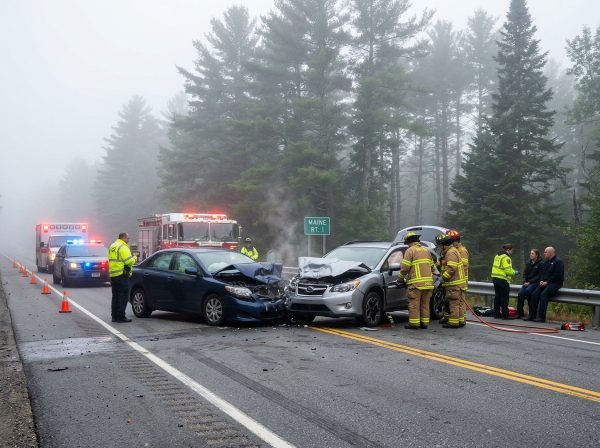
What Does It Mean to Collide Head-On — and Why Does It Matter?
When two vehicles collide head-on, their front ends strike each other as they travel in opposite directions. It is one of the most violent types of crashes on the road.
Here is what you need to know at a glance:
- Definition: A head-on collision occurs when the fronts of two vehicles moving toward each other make direct contact
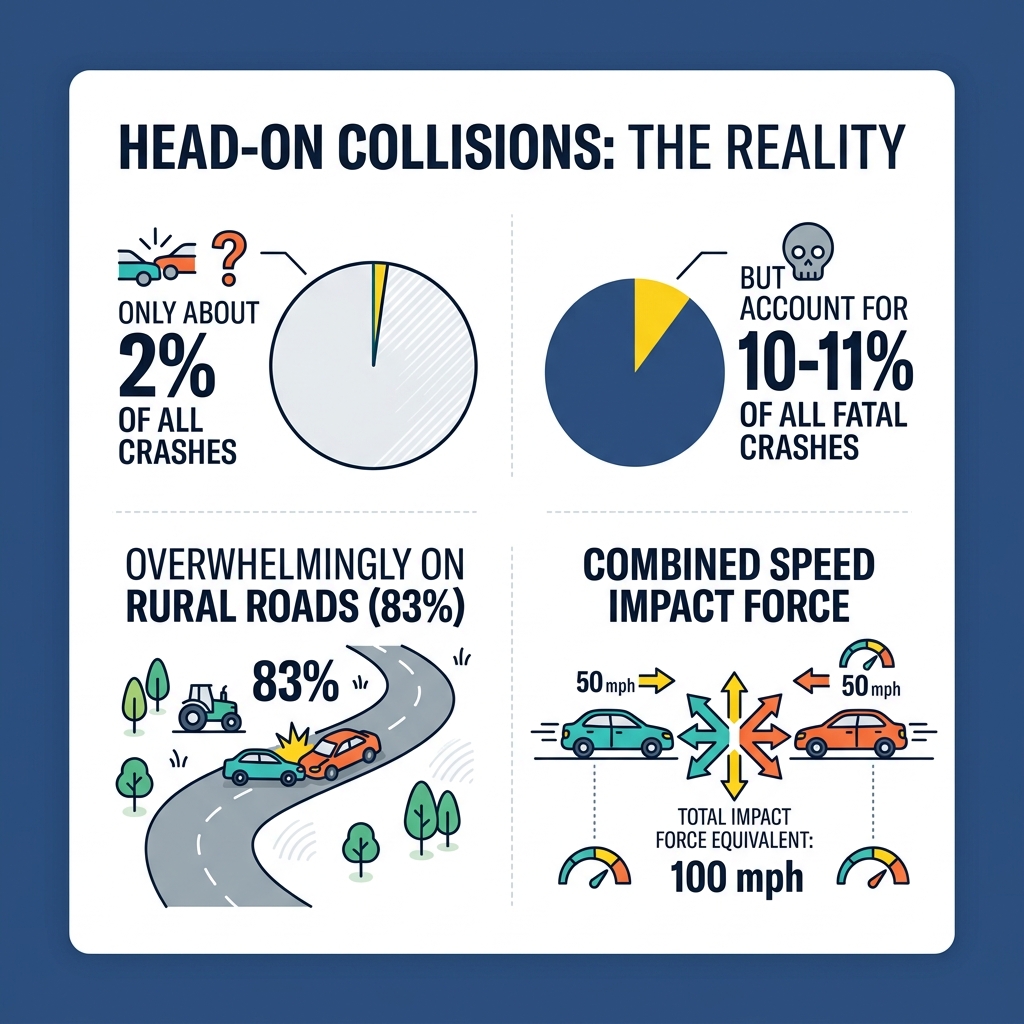
- Force: The impact combines the speed of both vehicles — two cars each traveling at 50 mph hit with the equivalent force of a 100 mph crash
- Fatality rate: Head-on crashes account for only about 2% of all collisions but nearly 10-11% of all fatal crashes in the U.S.
- Where they happen: 83% of head-on collisions occur on rural roads — exactly the kind found throughout Maine
- Common causes: Distracted driving, impaired driving, fatigue, and illegal passing on two-lane roads
These numbers tell a stark story. A crash that looks rare on paper is disproportionately deadly in practice.
If you or someone you love was hurt in a frontal crash in Maine, understanding what happened — and what your rights are — is the first step toward recovery. This guide walks you through the causes, the injuries, and the legal options available to you under Maine law.
The Physics and Dangers When Vehicles Collide Head-On
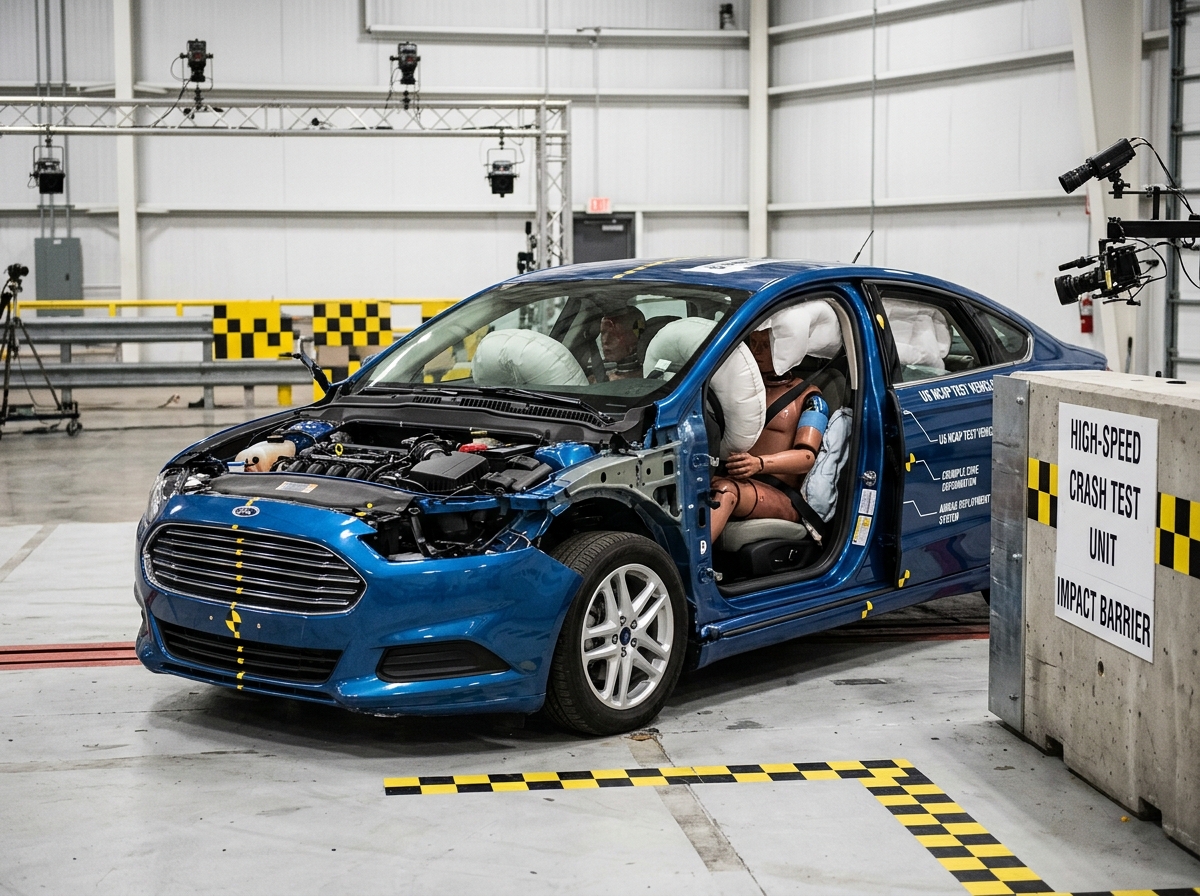
When you collide head-on, the kinetic energy is massive. In a typical rear-end collision, the leading car is often pushed forward, absorbing some of the energy. In a frontal impact, both vehicles come to a sudden, violent stop. This rapid deceleration causes the occupants’ bodies to continue moving forward at the pre-crash speed until they are stopped by seatbelts, airbags, or the dashboard.
Modern vehicle safety features, such as crumple zones and advanced airbag systems, are designed specifically to manage this energy. However, even the best safety technology has limits when facing the combined velocity of two opposing vehicles. This is why these crashes, though statistically rare, are responsible for a huge percentage of road fatalities.
Common Causes of Frontal Crashes in Maine
In our experience at Hardy Wolf & Downing, we see several recurring themes in Maine frontal crashes. Whether you are driving through the busy streets of Portland or the winding roads of Farmington, the causes often boil down to a few high-risk behaviors.
- Distracted Driving: This is a leading culprit. A driver in Scarborough or Windham looks down at a smartphone for just three seconds. At 55 mph, they have traveled the length of a football field. In that time, a slight drift of the steering wheel can cause them to cross the centerline and collide head-on with an unsuspecting traveler.
- Operating Under the Influence (OUI): Alcohol and drugs significantly impair a driver’s judgment and lane-keeping ability. Statistics show that impaired driving contributes to a massive portion of fatal crashes. An intoxicated driver may not even realize they have drifted into the wrong lane until it is too late.
- Winter Weather: Maine is famous for its winters, but snow and ice are major factors in roadway departure. A driver in Bethel or Rangeley might hit a patch of black ice on a curve, lose traction, and slide directly into the path of oncoming traffic.
- Driver Fatigue: Falling asleep at the wheel is a major issue on long stretches of Maine highway. A fatigued driver loses the micro-corrections needed to stay in their lane, often veering left into the opposing lane.
If you find yourself in the aftermath of such an event, it is vital to understand your legal options for head-on collision injuries.
Why You Are More Likely to Collide Head-On on Rural Roads
It might surprise you to learn that 83% of head-on collisions occur on rural roads. In Maine, much of our geography consists of two-lane roads without physical medians or barriers. When there is nothing but a painted yellow line separating you from a heavy logging truck or a speeding SUV, the margin for error is razor-thin.
Rural roads often feature:
- Narrow Shoulders: There is often nowhere to “steer out” of a collision if someone enters your lane.
- Blind Curves: You may not see an oncoming vehicle that has drifted over the line until you are seconds away from impact.
- High Speed Limits: Many rural Maine roads have speed limits of 50 mph or higher, increasing the force of any potential impact.
- Passing Maneuvers: Drivers often lose patience behind slow-moving farm equipment or trucks and attempt to pass on two-lane roads, leading to disastrous collisions with oncoming vehicles.
Research on roadway departure crashes highlights that these environments are the most dangerous because they lack the safety infrastructure—such as concrete Jersey barriers—found on major interstates.
Catastrophic Injuries Associated with Frontal Impacts
Because of the extreme forces involved when vehicles collide head-on, the resulting injuries are often life-altering. Even survivors of these crashes frequently face a long road of surgeries and rehabilitation.
- Traumatic Brain Injuries (TBI): The sudden stop can cause the brain to strike the inside of the skull. Symptoms might not appear immediately, masked by adrenaline, but can lead to long-term cognitive issues.
- Spinal Cord Damage: The violent “whiplash” motion or direct impact can fracture vertebrae or sever the spinal cord, potentially leading to paralysis.
- Internal Trauma: The force of the seatbelt or steering column can cause internal bleeding and damage to vital organs like the lungs, heart, or spleen.
- Lower Extremity Fractures: In a frontal crash, the engine block is often pushed back into the passenger cabin, crushing the legs and feet of the driver and front-seat passenger.
Understanding the types of injuries caused by head-on collisions is essential for ensuring you seek the right medical specialists and document your recovery for a legal claim.
Protecting Your Rights After a Maine Frontal Crash
Maine law is designed to help victims recover, but its specific rules can be confusing. If you are involved in a crash in Lewiston, Auburn, or any of our surrounding communities, you need to know how the state handles “fault.”
Maine follows a modified comparative negligence rule. This means that as long as the plaintiff’s fault is less than 50%, you can still recover damages. However, if a jury decides you were 50% or more at fault, you recover nothing. Crucially, in Maine, your compensation is not reduced by a simple percentage. Instead, the law states that the compensation is reduced by an amount reflecting the negligence of the plaintiff, not a percentage. This subtle distinction is why having a skilled trial attorney is so important—how your “amount” of negligence is argued can make a massive difference in your final settlement.
Standard Claims vs. Government Entity Claims
In some cases, the fault doesn’t lie solely with another driver. Sometimes, a road under construction or a lack of proper signage in a construction zone contributes to the crash. If a government entity (such as a state or municipality) is involved, the rules change significantly. For instance, government entities are not liable for sidewalks, and there are strict notice requirements.
| Feature | Standard Private Claim | Government Entity Claim |
|---|---|---|
| Statute of Limitations | 6 Years | 2 Years (with a catch) |
| Notice Requirement | None required before filing | Formal written notice within 365 days |
| Sidewalk Liability | Depends on the owner | No liability for government entities |
| Damages Cap | Generally no cap on economic | Often capped by the Tort Claims Act |
Proving Liability and Duty of Care
To win a personal injury case in Maine, you must prove the other party breached their “duty of care.” Every driver has a legal obligation to operate their vehicle safely. When they cross that yellow line and collide head-on with you, they have breached that duty.
Maine law also applies specific standards to property and construction. For premises liability, owners owe a duty of care to any non-trespasser. Furthermore, in cases involving road work or repairs, contractors have no independent duty to the public unless they created the problem that caused the injury.
Proving this requires a mountain of evidence:
- Police Reports: Officers from the Portland Police or Maine State Police will document the scene and often issue citations that serve as strong evidence of negligence.
- Witness Statements: People who saw the other driver swerving or speeding can provide critical testimony.
- Accident Reconstruction: Experts can examine skid marks and vehicle damage to determine exactly where the impact occurred—showing the other driver was in your lane.
- Medical Records: These link your injuries directly to the crash.
A deadly Casco crash serves as a tragic reminder of how quickly these investigations must begin to preserve evidence.
Frequently Asked Questions About Maine Frontal Crashes
How long do I have to file a lawsuit in Maine? In Maine, the statute of limitations is 6 years for most personal injury claims. This is one of the longest in the country, but you should never wait that long. Evidence disappears, and memories fade. Furthermore, if your claim involves a government entity, you must provide a formal written notice of claim within 365 days, or you lose your right to sue.
What are the minimum insurance requirements in Maine? Maine law requires all drivers to carry liability insurance. The minimums are:
- $50,000 per person / $100,000 per accident for bodily injury.
- $25,000 for property damage.
- $2,000 for medical payments.
- Uninsured/Underinsured motorist coverage of $50,000/$100,000.
What if the other driver was drunk? If alcohol was involved, the case becomes even more serious. You can read more about how alcohol is suspected in recent fatal head-on collisions and how that affects liability. In these cases, the negligent driver may also face criminal charges, but your civil case for damages is a separate matter. There are different, shorter time limits for cases involving alcohol.
Can I still recover money if I was partially at fault? Yes, as long as the plaintiff’s fault is less than 50%. If you were speeding slightly but the other driver crossed the centerline and hit you, a jury might find you partially responsible. Your total compensation would then be reduced by an amount reflecting your portion of the negligence, not a percentage.
Seeking Justice with Hardy Wolf & Downing
At Hardy Wolf & Downing, we have been a part of the Maine community since 1976. We aren’t just lawyers; we are neighbors who drive the same roads you do—from the Maine Mall area in South Portland to the hills of Farmington.
When you collide head-on with another vehicle, your life is turned upside down in a fraction of a second. The insurance companies often try to minimize your pain or shift the blame onto you. Our job is to stand in the gap. We are experienced Maine trial attorneys who are not afraid to take a case to a jury to ensure our clients receive the justice they deserve.
We represent people who have suffered serious physical injuries due to negligence. Whether you are in Portland, Lewiston, or any of our other service locations, we offer empathetic and expert legal representation.
Key Takeaways:
- Head-on collisions are rare but exceptionally deadly due to the physics of combined speed.
- Maine’s rural roads are the primary site for these accidents.
- The statute of limitations is 6 years, but there are much shorter timelines if a government entity or the service of alcohol is involved.
- Maine’s modified comparative negligence rule allows recovery if the plaintiff’s fault is less than 50%, with compensation reduced by an amount reflecting negligence.
If you have been injured, don’t navigate the complex Maine legal system alone. Reach out for a consultation to learn how we can help you reclaim your life and secure the compensation you need to recover.