


The moments following a collision on Maine roads are often chaotic. Amid the adrenaline and stress, it is incredibly easy to make simple errors that insurance companies will later weaponize to devalue or deny your claim.
One of the most common and damaging mistakes is to apologize or admit fault at the scene. Saying “I’m sorry,” “I didn’t see you,” or “I should have stopped sooner” out of polite habit can be legally classified as a “Party Admission.” Insurance adjusters routinely use these statements to shift liability, even if the other driver was entirely responsible for the crash. When communicating with the other driver or law enforcement, stick strictly to the facts of what happened without speculating on blame.
Another critical error is failing to document the scene thoroughly. Physical evidence is highly perishable. Weather conditions, tire tracks, and vehicle positions change rapidly. If you are physically able, you should immediately take comprehensive photos and videos of:
- The damage to all vehicles involved from multiple angles
- Skid marks, debris fields, and road conditions
- Traffic signals, stop signs, and lane markings
- The physical injuries you and your passengers sustained
For a detailed step-by-step breakdown of handling the immediate aftermath of a collision, read our guide, What to Do After a Car Accident in Maine.
Finally, in the digital age, posting about your accident on social media is a massive risk. Insurance investigators routinely monitor public and private social media profiles. A seemingly harmless photo of you smiling at a family dinner, or a post saying “I’m doing okay,” can be taken out of context and used as evidence that your injuries are not as severe as you claim. To safeguard your recovery, keep all details of the accident, your injuries, and your rehabilitation completely off social media until your case is fully resolved.
Why is delaying medical treatment a major mistake?
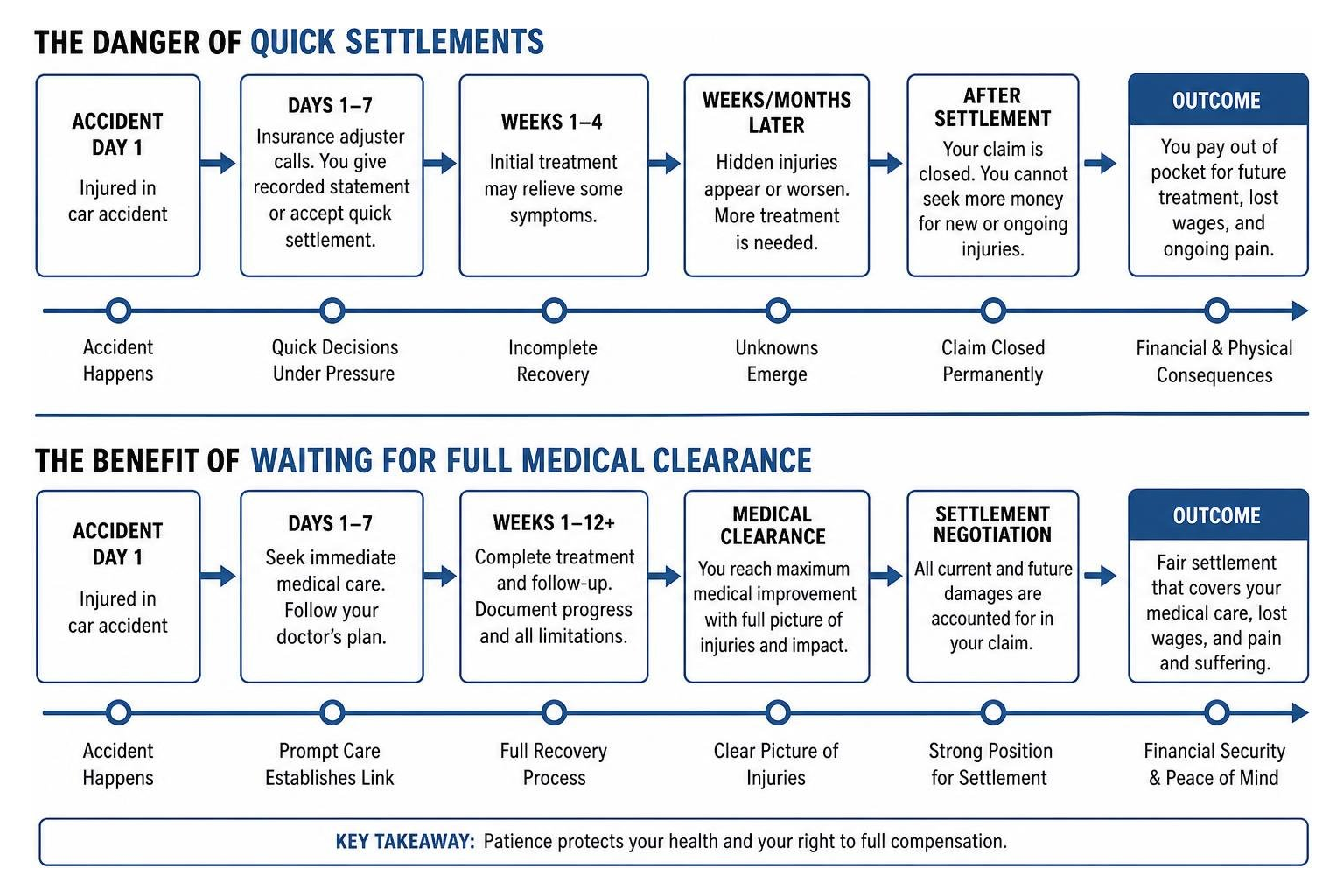
Under Maine law, injury victims have a legal duty to “mitigate damages.” This means you must take reasonable steps to minimize the financial and physical impact of your injuries. Failing to seek immediate medical attention is one of the easiest ways to violate this duty, giving the insurance company a perfect excuse to deny your claim.
Many serious car accident injuries, such as whiplash, concussions, internal bleeding, and soft-tissue damage, do not present symptoms immediately due to the body’s natural adrenaline response. If you wait days or weeks to see a doctor, the insurance adjuster will argue that:
- Your injuries were not actually caused by the car accident, but rather by an unrelated, subsequent event.
- Your injuries are not as severe as you claim, because a genuinely injured person would have sought immediate care.
- You allowed your condition to worsen by failing to get prompt medical treatment.
Seeking immediate medical evaluation at a hospital or clinic in Portland or Lewiston establishes a clear, official timeline. It links your physical injuries directly to the collision, making it much harder for the insurance company to dispute the cause of your pain.
What are the risks of giving a recorded statement or accepting an early settlement?
Shortly after your accident, you will likely receive a phone call from a friendly insurance adjuster representing the at-fault driver. They may ask you to provide a recorded statement “just to get your side of the story” or offer you a quick cash settlement to resolve the matter.
You are under no legal obligation to provide a recorded statement to the other driver’s insurance company. Adjusters are highly trained negotiators whose primary goal is to protect their employer’s bottom line. They use polite, conversational tactics to guide you into making statements that downplay your pain, suggest you were distracted, or imply you are recovering faster than you actually are.
To see how these tactics play out in real life, read our article titled “The Insurance Company Said I’d Get Less Money With a Lawyer – Here’s What Actually Happened.”
Similarly, accepting an early settlement offer is a critical mistake. These initial offers are almost always lowball estimates designed to close your file before you know the true extent of your injuries. Once you sign a release form and accept a settlement check, your claim is permanently closed. If you later discover that you need surgery or extensive physical therapy, or that you cannot return to work, you cannot reopen the claim to seek additional compensation.
How Do Maine’s Specific Laws Impact Your Injury Claim?
Maine operates under a traditional “fault” or “tort” car insurance system. This means the driver who caused the accident is financially responsible for the resulting damages, including medical bills, lost wages, and pain and suffering. To understand the minimum coverages required in our state, refer to Maine’s Car Insurance Requirements Explained.
Navigating a fault-based system requires a deep understanding of Maine’s specific statutory deadlines and liability rules.
| Claim Type | Filing Deadline (Statute of Limitations) | Notice Requirement |
|---|---|---|
| Standard Personal Injury Claim | 6 Years (from date of accident) | None |
| Claim Against a Government Entity | 2 Years (from date of accident) | Formal written notice within 365 days |
How does Maine’s modified comparative negligence rule work?
Maine applies a modified comparative negligence rule with a strict 50% threshold.
Under this rule, an injured plaintiff can recover damages only if their share of fault for the accident is less than 50%. If you are found to be 50% or more at fault for the collision, you are legally barred from recovering any compensation whatsoever.
If you are partially at fault but your liability is less than 50% (for example, you were speeding slightly while the other driver ran a red light), you can still recover damages. However, under Maine law, your compensation is reduced by an amount reflecting your negligence, rather than a strict mathematical percentage.
Because of this rule, insurance adjusters will work tirelessly to shift even a small portion of the blame onto you. If they can successfully argue that you were 50% responsible, they do not have to pay you a single penny. An experienced trial attorney knows how to gather the evidence necessary to prove the other driver’s liability and protect your compensation.
What are the deadlines for filing a claim in Maine?
Under Title 14, §752 of the Maine Revised Statutes, the standard statute of limitations for personal injury claims is six years from the date of the accident. While this is one of the most generous filing windows in the country, waiting to act is highly risky. Over six years, physical evidence disappears, skid marks fade, vehicles are repaired or scrapped, witnesses move away, and memories become unreliable.
Furthermore, if your accident involved a government entity — such as a state, county, or municipal vehicle (like a local school bus or a MaineDOT plow) — the rules change dramatically. You must file a formal, written notice of claim that strictly complies with Maine law within 365 days of the injury. Failing to file this notice within the one-year window will permanently bar you from pursuing compensation.
How Can an Experienced Maine Trial Attorney Protect Your Rights?
Attempting to handle a complex injury claim on your own often puts you at a severe disadvantage against multi-billion-dollar insurance corporations. For a detailed look at the pitfalls of self-representation, read Why You Shouldn’t Represent Yourself in a Personal Injury Claim.
An experienced Maine trial attorney protects your rights by taking over all communication, negotiations, and administrative burdens. This shields you from aggressive insurance adjusters and allows you to focus entirely on your physical recovery.
At Hardy Wolf & Downing, we prepare every single case as if it is going to trial. This strategic approach sends a clear message to the insurance company: we will not accept a lowball settlement, and we are fully prepared to present your case to a Maine jury if they refuse to offer fair compensation. This preparation provides maximum leverage during settlement negotiations, often resulting in significantly higher payouts.
To determine if legal representation is necessary for your specific situation, review our guide: Should I Get a Lawyer for a Car Accident That Wasn’t My Fault?.
When choosing a car accident lawyer in Maine, look for a firm with deep roots in local communities such as Portland and Lewiston, extensive courtroom experience, and a transparent contingency fee structure in which you pay absolutely nothing upfront.
Frequently Asked Questions About Maine Car Accident Claims
Is Maine a no-fault state for car accidents?
No, Maine is an at-fault state. The driver who caused the accident is financially liable for your damages. However, if your own auto insurance policy includes Medical Payments (MedPay) coverage, it can be used to pay your immediate medical bills regardless of who was at fault, and the costs are later reimbursed through the final settlement.
What should I do if the other driver is uninsured?
Maine law requires all auto insurance policies to include Uninsured/Underinsured Motorist (UM/UIM) coverage. If you are hit by an uninsured driver or a driver whose policy limits cannot cover your damages, you can file a claim under your own UM/UIM policy to recover compensation for your medical bills and lost wages.
How much does it cost to hire a car accident lawyer in Maine?
At Hardy Wolf & Downing, we operate on a contingency fee basis. This means there are no upfront costs, no hourly fees, and no out-of-pocket expenses. We only get paid if we successfully secure a settlement or a jury verdict in your favor.
Summary and Key Takeaways
- Call the police immediately: Ensure an official crash report is filed to establish a neutral record of the accident.
- Seek prompt medical care: Protect your health and establish a direct, documented link between the crash and your physical injuries.
- Watch what you say: Never apologize or admit fault at the scene, and politely decline to provide a recorded statement to the other driver’s insurer.
- Document everything: Take photos of the vehicles, road conditions, and your physical injuries.
- Stay off social media: Keep all details of your recovery and the accident private.
- Consult a local trial attorney: Protect your rights under Maine’s modified comparative negligence rule and ensure you do not miss critical deadlines.
If you or a loved one has been injured in a collision in Portland, Lewiston, or anywhere in Maine, contact the experienced trial attorneys at Hardy Wolf & Downing today for a free, no-obligation consultation at Hardy Wolf & Downing Auto Accident Representation.

